


Intellectual Property Law
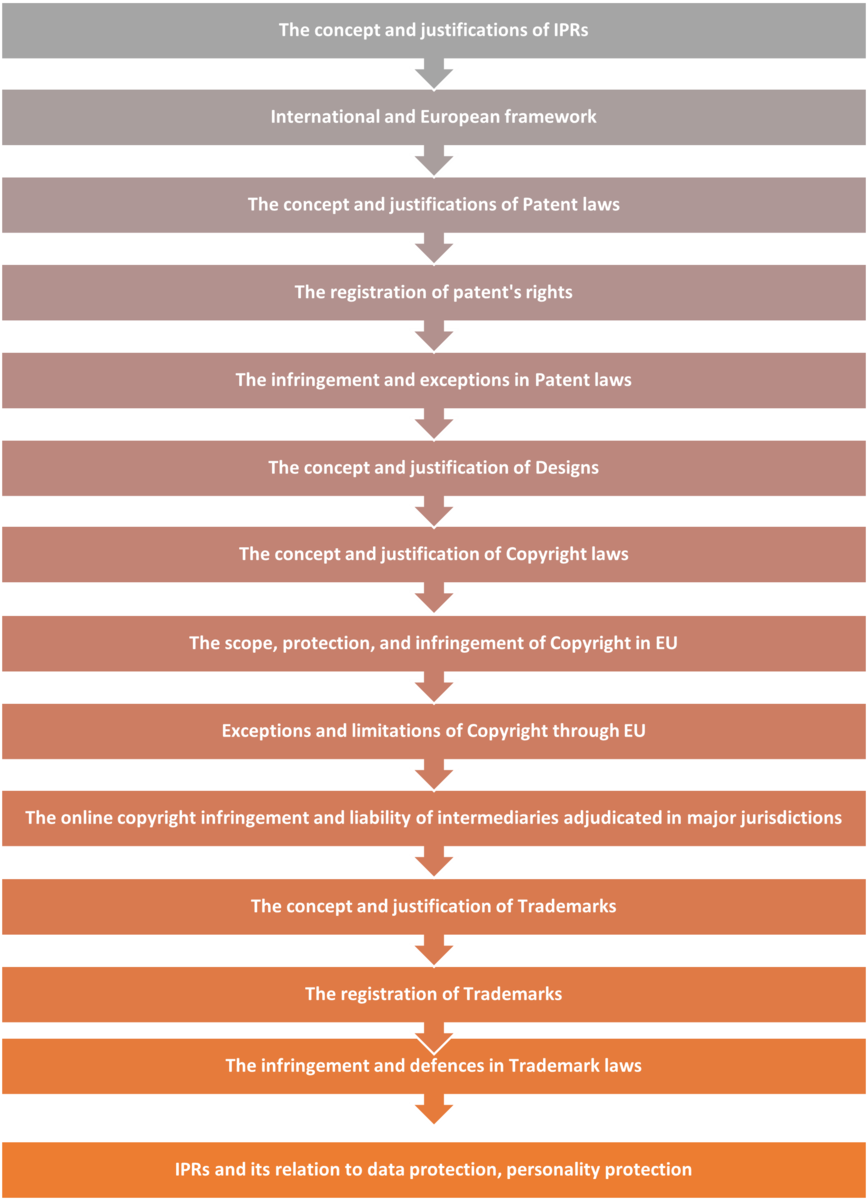
Topics
- The concept and justifications of IPRs
- International and European framework
- The concept and justifications of Patent laws
- The registration of patent's rights
- The infringement and exceptions in Patent laws
- The concept and justification of Designs
- The concept and justification of Copyright laws
- The scope, protection, and infringement of Copyright in EU
- Exceptions and limitations of copyright through EU
- The online copyright infringement and liability of intermediaries adjudicated in major jurisdictions
- The concept and justification of Trademarks
- The registration of Trademarks
- The infringement and defences in Trademark laws
- IPRs and its relation to data protection, personality protection
Sylĺabus
BASIC MATERIALS AND RESOURCES
• Intellectual Property Law – Jennifer Davis
• Intellectual Property Law: Text, Cases, and Materials - Tanya Frances Aplin, Jennifer Davis
• Intellectual Property: Patents, Copyrights, Trademarks & Allied Rights – Cornish, Llewelyn, Aplin;
• The Intellectual Property Review – Stanislas Roux-Vaillard
• World Copyright Law – J. A. L. Sterling.
• European Convention on Human Rights
• Berne Convection on the Protection of Literary and Artistic Works 1886
• International Convention for the Protection of Performers, Producers of Phonograms and Broadcasting Organisation 1961
• Paris Convection adopted 1883
• Agreement on Trade Related Aspects of Intellectual – TRIPS
• WIPO COPYRIGHT TREATY 1996 - WCT
• WIPO PERFORMANCES AND PHONOGRAMS TREATY 1996 - WPPT
• WIPO BEIJING TREATY ON AUDIVISUAL PERFORMANCES - BEIJING TREATY
• Anti-Counterfeiting Trade Agreement ACTA
• The Comprehensive and Economic Trade Agreement – CETA
• Patent Cooperation Treaty – PCT
• Patent Law Treaty – PLT
• European Patent Convention – EPC
• Community Patent Convention - CPC
• Supplementary Protection Certification Regulation - SPC Regulation
• Directive on the legal protection of biological inventions (Biotechnology Directive)
• Design Directive 98/71/EC of the European Parliament and of the Council of 13 October 1998 on the legal protection of designs
• Council Regulation (EC) No. 6/2002 of 12 December 2001 on Community designs
• Directive on the harmonisation of certain aspects of copyright and related rights in the information society ("InfoSoc Directive"), 22 May 2001
• Directive on rental right and lending right and on certain rights related to copyright in the field of intellectual property ("Rental and Lending Directive"), 12 December 2006
• Directive on the resale right for the benefit of the author of an original work of art ("Resale Right Directive"), 27 September 2001
• Directive on the coordination of certain rules concerning copyright and rights related to copyright applicable to satellite broadcasting and cable retransmission ("Satellite and Cable Directive"), 27 September 1993
• Directive on the resale right for the benefit of the author of an original work
• Directive on the legal protection of computer programs (“Software Directive”), 23 April 2009
• Directive on the enforcement of intellectual property right (“IPRED”), 29 April 2004
• Directive on the legal protection of databases (“Database Directive”), 11 March 1996
• Directive on the term of protection of copyright and certain related rights amending the previous 2006 Directive (“Term Directive”), 27 September 2011
• Directive on certain permitted uses of orphan works (“Orphan Works Directive”), 25 October 2012
• Directive on collective management of copyright and related rights and multi-territorial licensing of rights in musical works for online use in the internal market (“CRM Directive”), 26 February 2014
• Directive on certain permitted uses of certain works and other subject matter protected by copyright and related rights for the benefit of persons who are blind, visually impaired or otherwise print-disabled (Directive implementing the Marrakech Treaty in the EU), 13 September 2017
• Directive (EU) 2019/790 of the European Parliament and of the Council of 17 April 2019 on copyright and related rights in the Digital Single Market and amending Directives 96/9/EC and 2001/29/EC
• Regulation (EU) 2017/1001 of the European Parliament and of the Council of 14 June 2017 on the European Union trade mark
• All lectures, materials and cases provided by the lecturer
SEMINAR TOPICS
1. The concept and justifications of IPRs
Students will gain knowledge about the waste extent of IPRs, its concept and justifications in the legal system. The justifications of IPRs - Unjust enrichment, Natural rights, Personality theory, Human Rights, the utilitarian Justifications, Law and economic approach, The public domain will be explained.
2. International and European framework
Students will gain knowledge about the legislative history of IPRs. The content and meaning of the most important legal act will be covered. The seminar focuses on IP conventions, multilateral and bilateral agreements and EU legislative.
3. The concept and justifications of Patent laws
Students will gain knowledge about justifications and source of patent law. The seminar focuses on the patentable subject matter and exceptions to patentability.
4. The registration of patent's rights
Students will gain knowledge about the patent registration in EU. The seminar focuses on novelty, inventive step and industrial application. From practical point of view, students will learn about the registration under EPC and CPT through EPO.
5. The infringement and exceptions in Patent laws
Students will gain knowledge about infringing acts in EU. The seminar focuses on the construction of claims and exceptions.
6. The concept and justification of Designs
Students will gain knowledge about the registration process of designs in EU. The seminar focuses on registered and unregistered designs.
7. The concept and justification of Copyright laws
Students will gain knowledge about justifications of Copyright and sources of law. The seminar focuses on authorship, exploitation rights, duration of Copyright, moral and economic rights.
8. The scope, protection, and infringement of Copyright in EU
Students will gain knowledge about infringement of Copyright. The seminar focuses on the primary and secondary infringement and related case law, attention is paid also to infringement in digital environment.
9. Exceptions and limitations of Copyright through EU
Students will gain knowledge about exceptions and limitations of copyright under EU legislative. The seminar focuses on harmonized exceptions and limitations and related case law.
10. The online copyright infringement and liability of intermediaries adjudicated in major jurisdictions
Students will gain knowledge about online copyright infringement and who might be responsible under EU legislative. The seminar focuses on the liability of intermediaries and related case law.
11. The concept and justification of Trademarks
Students will gain knowledge about justifications for the protection of registered trademarks. The seminar focuses on trademarks as valuable commercial assets and absolute grounds for refusal of a trademark registration.
12. The registration of Trademarks
Students will gain knowledge about the trademark registration in EU. The seminar focuses on main steps of the registration. From practical point of view, students will learn about the registration through EUIPO.
13. The infringement and defences in Trademark laws
Students will gain knowledge about acts infringing EU trademark law. The seminar focuses on the construction of infringement and related case law.
14. IPRs and its relation to data protection, personality protection
Students will gain knowledge about the intersection of IPRs and rights of a data subject. The seminar focuses on personality protection while adhering to protection of IPRs and related case law.
Information on completing the course
Information according to Art. 11 par. 4 of the Study Rules of the Comenius University in Bratislava, Faculty of Law for the teacher:
Mgr. Jana Zigo, PhD., LL.M
JUDr. Lukáš Macko, PhD.
I. Semester/academic year: summer semester, 2025/2026
II. Study program/degree/form: law/master's/full-time
III. Course title: Intellectual Property Law
IV. Scope of compulsory participation in educational activities
a) Student participation in seminars is mandatory.
b) If the student does not participate in three seminars, his absence is excused.
V. Conditions under which a student can make up for non-participation in seminars:
Only 3 absences are allowed.
VI. Specification of the method of evaluation of study results, including specification of the method and conditions for completing the remedial continuous evaluation:
Continuous assessment – a total of 100 points consists of two parts:
1. part: 30% (continuous assessment based on activities at seminars, case studies,
students' legal analysis)
- Case Studies/Legal Analyses (30%):
- After each thematic block (Patents 10%, Copyright 10%, and Trademarks 10%), students will complete case studies or legal analyses.
2. part: 70% (written exam consisting of case studies and theoretical knowledge divided into two parts during the semester)
Students can use all available sources of legal information, especially statutes, commentaries, case law, legal literature, and legal information systems.
VII. Dates of continuous evaluation, thematic headings of individual dates of continuous evaluation;
a) Continuous assessment
1. part written exam 30.3-3.4.2026
2. part written exam 11.5-15.5.2026
b) Thematic headings: available on the website of the institute (see above).
VIII. Information on alternative options for meeting the conditions of the continuous evaluation, which are not the overall remedial terms of the continuous evaluation according to Art. 13 par. 4 of the study rules of the faculty;
Remedial terms for the continuous evaluation will be determined only for students who did not participate in the regular term of the continuous evaluation and who proves that could not participate in this form of examination for objective and serious reasons.
The remedial term for continuous evaluation will be 18.5. – 22.5.2026.
IX. Information on whether a condition for taking the exam is the achievement of the prescribed level of continuous evaluation or the prescribed scope of compulsory participation in educational activities.
-
X. Additional information
The course syllabus is available on the institute's website (see above).
In Bratislave, 14.2.2026
Mgr. Jana Zigo, PhD., LL.M